Sign in. It’s quick, free and it’s up to you.
An account is an optional way to support the work we do. Find out more.
Sign in. It’s quick, free and it’s up to you.
An account is an optional way to support the work we do. Find out more.
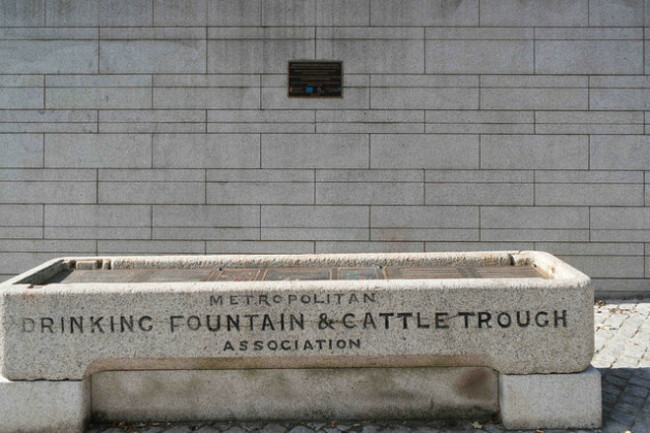
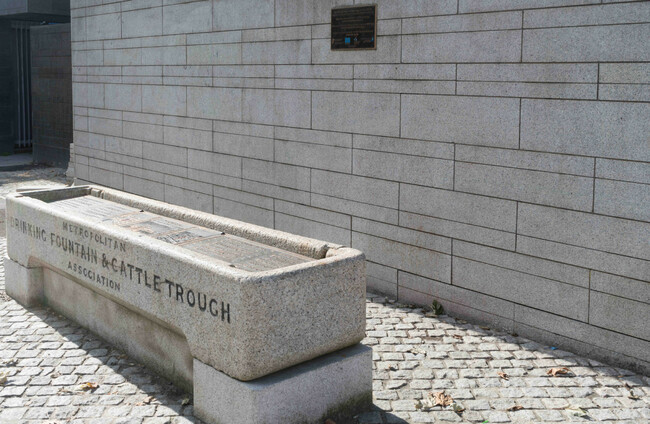
SAUNTER THROUGH SMITHFIELD and you’ll discover a substantial stone construction resembling, well… a bath.
Look closer, and you’ll spot it’s less of a bathing vessel and more of a trough. Once a drinking spot for animals, the long stone structure is still branded with the inscription “Metropolitan Drinking Fountain and Cattle Trough Association”.
So how did a trough find its way to Dublin’s city centre, and what on earth was the MDFCTA?
The first clue lies in the location: Haymarket Square, once a thriving livestock market on the edge of Dublin’s city centre.
As noted on the official Metropolitan Drinking Fountain and Cattle Trough Association website, the Smithfield trough is just one of three scattered around Dublin.
Each hollowed granite drinking vessel was gifted by the organisation, founded in 1859 by Samuel Guerney and Edward Thomas Wakefield, in London.
Further investigation on the Metropolitan Drinking Fountain and Cattle Trough Association site documents two similar troughs, in Dublin, both reported as “lost and missing”.
These two absent drinking fountains were apparently erected in 1931 at Harold’s Cross and 1938 along South Dublin Quays, respectively. Their current whereabouts remain unknown. Amongst these missing vessels are lost troughs recorded from Kildare, Waterford and Limerick, also.
What we know about the cattle trough situated in Smithfield is that it was originally located in Bethnal Green, London. It was functional between 1880 until 1938, at this location, before it was donated by John Henry Buxton, Guerney’s grandson. Buxton had the trough transported to its current Smithfield location in 1951.
Today, you’ll see a bronze plate covering the hollowed vessel. The plaque is inscribed with an in memoriam to Phillip Twells (1808-1880), a former member of the Conservative Party and Member of Parliament.
While the trough is no longer functional and the monthly livestock markets have ceased, it’s presence is a timely reminder of Smithfield’s former trading history.
To embed this post, copy the code below on your site




have your say